
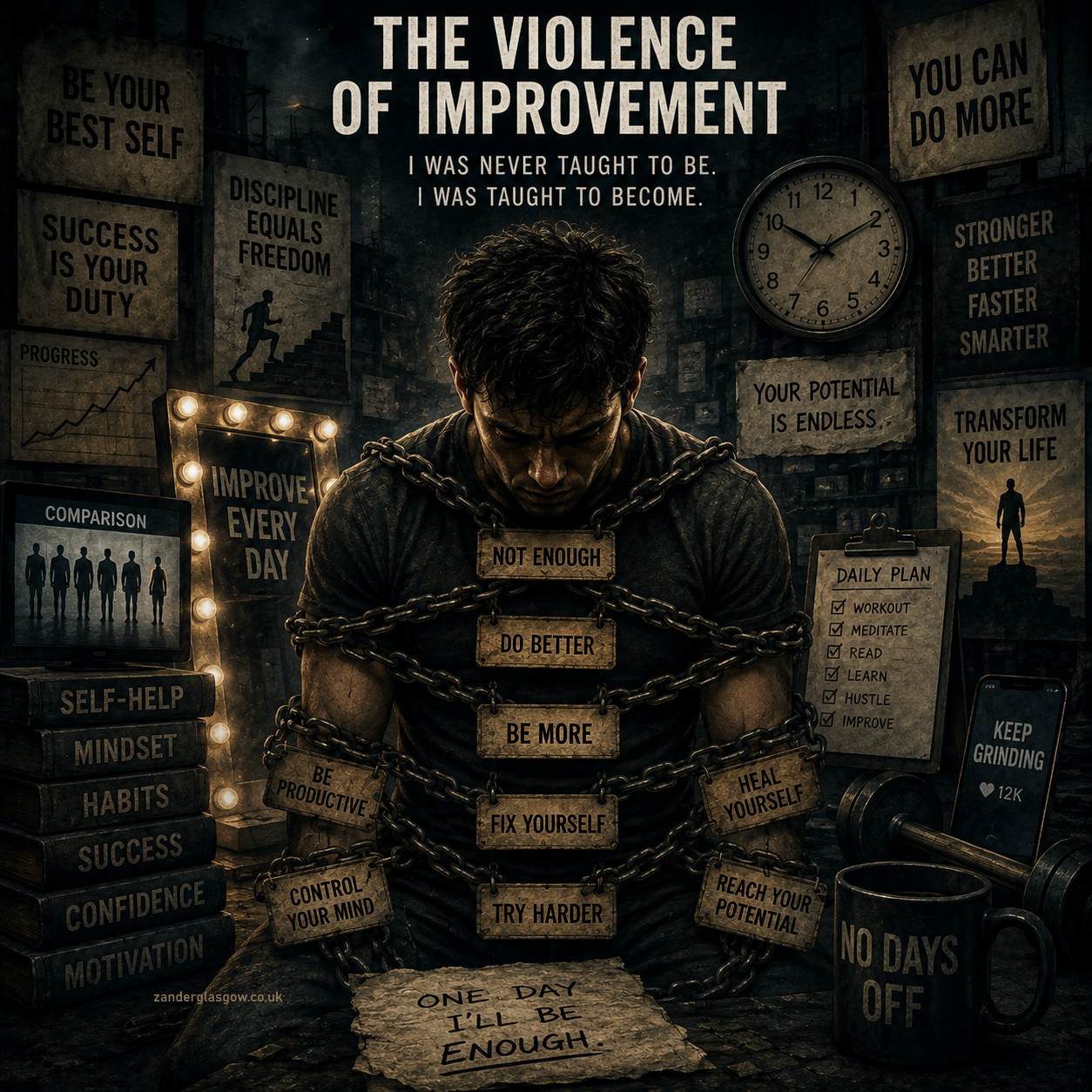
People are taught very early that who they are is insufficient.
The message appears everywhere.
- Improve yourself.
- Work on yourself.
- Heal yourself.
- Strengthen yourself.
- Optimise yourself.
- Become your best self.
- Reach your potential.
- Fix your weaknesses.
- Master your mind.
- Transform your life.
The language changes across cultures, industries, religions, schools, families, and ideologies, but the central message remains the same: "Who I am now is not enough".
Very few ever stop to examine the psychological consequences of this message because the message appears virtuous.
Improvement is treated as intelligence.
Improvement is treated as maturity.
Improvement is treated as responsibility.
The person who questions improvement is treated as lazy, bitter, resistant, weak, damaged, or afraid. Society rarely questions the improvement structure itself. Society questions only whether the individual is improving fast enough. And, the pressure begins early.
Children are measured academically, compared socially, corrected behaviourally, and evaluated emotionally. Approval becomes linked to performance almost immediately. The child learns that achievement creates value. And then, adulthood expands the same structure.
More productivity.
More discipline.
More confidence.
More success.
More healing.
More emotional regulation.
More social status.
More achievement.
More optimisation.
The human being becomes a permanent psychological project. Most people never notice the hidden violence underneath the structure because the violence appears socially acceptable.
The violence is subtle.
The violence is the continuous suggestion that the present self is inadequate.
The contradiction becomes even more deceptive because modern culture now speaks in two voices simultaneously.
One voice says:
“You are enough.”
“You are not broken.”
“You are worthy as you are.”
The other voice says:
“Improve yourself.”
“Heal yourself.”
“Become better.”
“Fix your patterns.”
“Reach your potential.”
The reassurance softens the violence without removing it.
The individual is told “You are enough,” while being surrounded by constant messages implying insufficiency.
The contradiction creates psychological confusion.
If I am already enough, why must I endlessly improve?
If I am not broken, why is my entire existence treated as a repair project?
The system survives because the comforting language disguises the underlying assumption that the present self remains inadequate.
Any person who is taught perpetual insufficiency will eventually lose touch with simple existence.
Life becomes measurement.
Measurement against ideals.
Measurement against ambition.
Measurement against social expectation.
Measurement against internalised standards inherited through conditioning.
Then, self-worth becomes unstable because the standards constantly move.
Modern self-improvement culture survives by continuously manufacturing inadequacy. The industry could not survive after convincing people that they are already complete. Entire economies depend upon psychological dissatisfaction.
Advertising depends upon dissatisfaction.
Social media depends upon dissatisfaction.
Status systems depend upon dissatisfaction.
Much of modern therapy culture depends upon dissatisfaction.
Much of motivational culture depends upon dissatisfaction.
The person must continue feeling incomplete for the system to continue functioning. This is rarely acknowledged directly because improvement has been moralised.
The improving person is praised.
The non-improving person is judged.
Improvement has become a virtue.
Then, inadequacy becomes identity. At that point, the individual begins participating voluntarily in self-rejection.
The person monitors thoughts constantly.
Monitors habits constantly.
Monitors productivity constantly.
Monitors emotional responses constantly.
Monitors appearance constantly.
Monitors social perception constantly.
Self-surveillance becomes normal.
Many people now experience their own minds as management problems. The relationship with self has become mechanical.
The person becomes divided internally:
the observer and the observed,
the improver and the insufficient self,
the ideal and the failure.
Conflict becomes permanent because the ideal never fully arrives.
The future becomes psychologically necessary.
“I will become better.”
“I will finally heal.”
“I will eventually become enough.”
The promise of future completion sustains the entire structure. Without future improvement, many people no longer know how to relate to themselves.
This creates a disturbing possibility.
- What if self-improvement only functions as socially approved self-rejection?
- What if the person constantly trying to improve never actually escapes dissatisfaction because dissatisfaction itself fuels the process?
Many people spend decades attempting to repair an identity structure that was built upon insufficiency from the beginning. The self-improvement structure deepens the wound while claiming to heal the wound.
The person becomes trapped inside endless psychological modification.
One technique replaces another.
One identity replaces another.
One philosophy replaces another.
One optimisation system replaces another.
The structure remains untouched.
The assumption remains untouched:
“I am not enough as I am.”
Very few people examine the possibility that the problem began with the primary assumption.
This does not mean people stop learning, adapting, creating, building, studying, training, or developing skills. Skill development is not the same as psychological self-rejection.
A person may learn a language.
Develop a skill.
Strengthen the body.
Study mathematics.
Improve technical competence.
None of this requires psychological self-rejection. The confusion begins when functional learning becomes psychological identity.
The pianist practices piano.
The athlete trains the body.
The engineer studies engineering.
Simple.
Learning is natural.
Practical growth is natural.
Physical adaptation is natural.
But psychological insufficiency has become institutionalised.
The modern human being is taught to relate to existence through feelings of inadequacy. Ambition has become emotional survival.
The danger becomes greater when improvement enters the domain of spirituality.
The ego then seeks superiority through enlightenment, healing, consciousness, morality, purity, detachment, discipline, awakening, or transcendence.
Spiritual ambition becomes psychologically indistinguishable from material ambition.
Only the language changes.
The self still pursues completion.
The self still pursues superiority.
The self still pursues permanence.
Because of this, spirituality has become another marketplace built upon inadequacy. The structure survives because hope survives.
Hope says, “One day I will finally become enough.” But the person pursuing enoughness through endless improvement rarely notices the central contradiction.
The self being improved is the very structure claiming insufficiency.
The system feeds itself.
People spend their entire lives trying to become acceptable to themselves through endless self-modification.
Very little attention is given to the possibility that the violence began the moment existence became psychologically insufficient.
