
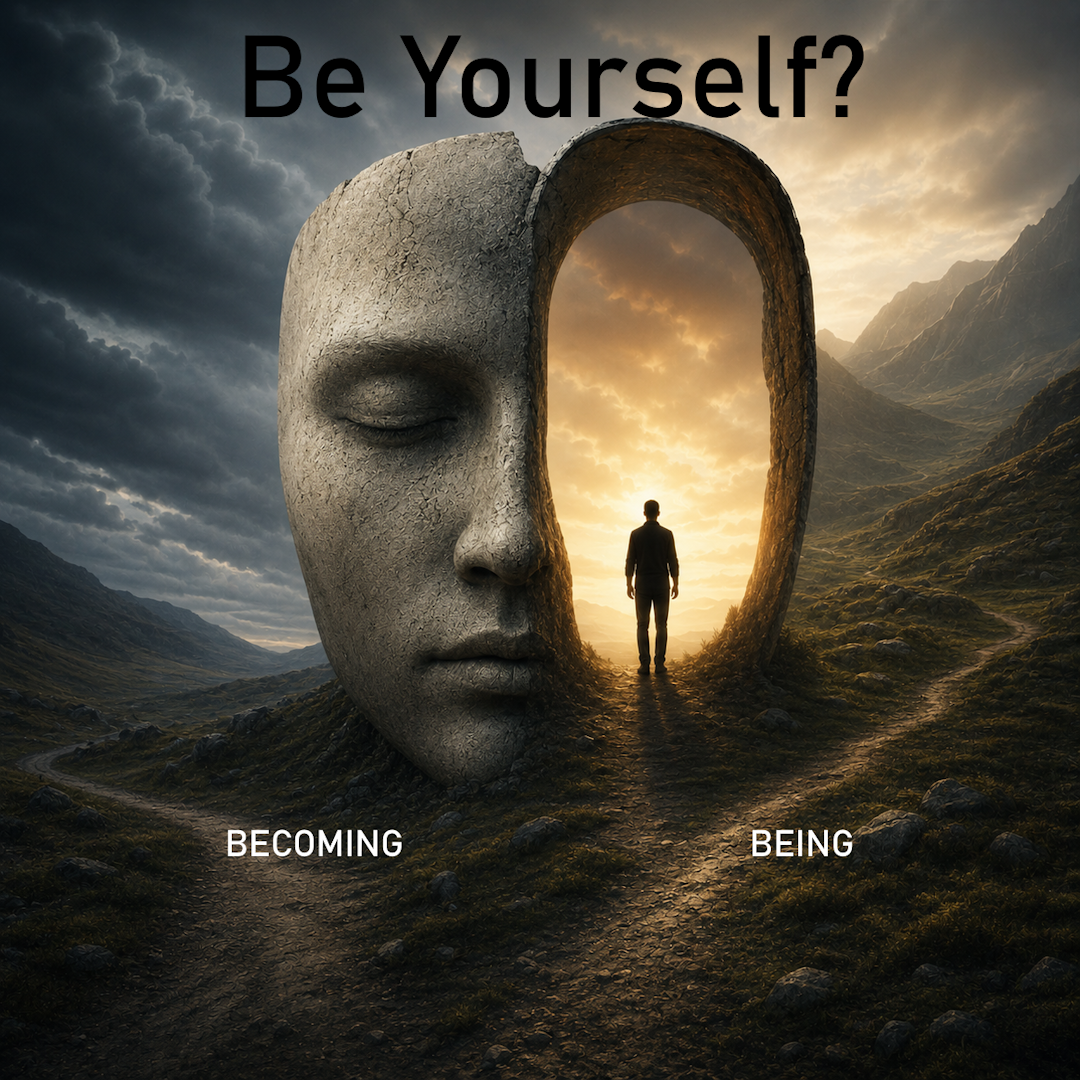
Few phrases are repeated as frequently as "Be yourself."
Regarded as wisdom by parents, teachers, and friends, and echoed in books and speeches, this advice is rarely examined for its actual meaning or practical value.
Who has genuinely considered what this phrase means with absolute sincerity?
Although the instruction appears straightforward, closer examination reveals underlying complexities.
What exactly is this self one is supposed to be?
Most people assume the answer is already known.
But is it?
To understand this, consider the earlier discourses on how identity forms.
A child enters a world already filled with language, values, expectations, rewards, punishments, fears, ambitions, and beliefs. The child learns what is acceptable and what is shameful. The child also learns what gains approval and what invites rejection.
Through this process, a personality gradually emerges.
Although the process appears personal, it is primarily shaped by inherited influences.
Taking this observation seriously, an uncomfortable question naturally arises.
What remains underneath everything that has been acquired?
Many people answer immediately.
"My true self."
But, exactly what is that?
Have I observed this ‘true self’ directly, or is this simply another inherited idea?
The phrase "be yourself" presupposes that beneath conditioning exists a core self, untouched by external influence and merely awaiting discovery.
Most people never question this assumption. It feels reassuring.
If life feels confusing, there must be a real self to find. If life feels conflicted, there must be a real self to return to. If identity feels unstable, there must be a deeper identity somewhere underneath.
What happens?
One identity is questioned. Another identity immediately appears.
One person tries to abandon social labels.
Another person decides to adopt authenticity.
Yet another person rejects conformity.
And, each person begins searching for their real self.
Although the language surrounding the self may change, the underlying pursuit remains constant. The search for 'the real self' is based on the persistent assumption that there exists a correct self to attain.
The inquiry doesn’t stop there, however. There is an even deeper version of the same movement. It appears within some religions, spirituality, and systems of self-inquiry. For centuries, people have asked, "Who am I?"
It’s an unusual question, to which every answer seems inadequate.
One’s name is not the answer.
One’s profession is not the answer.
One’s nationality is not the answer.
One’s personality is not the answer.
And, no belief is ever the answer.
Each of these answers belongs to memory; to what has been accumulated.
The question "Who am I?" reveals an aspect that the mind finds difficult to comprehend. This may explain the question's enduring perceived relevance. Frequently, the question is prematurely answered, and the process of inquiry is replaced by a conclusion. Thereby, people start talking about the true self, the higher self, the soul, pure awareness, consciousness, the witness, and so on.
Different traditions use different verbiage while the structure remains similar.
> Something permanent is proposed.
> Something ultimate.
> Something untouched by change.
> Something that can supposedly be discovered.
The pattern is difficult to ignore.
The question creates uncertainty, disrupts identity, and reveals a lack of knowledge.
The answer restores certainty, creates a new identity, and claims to know.
Whether the answer is psychological or spiritual may be less important than it first appears.
The movement itself deserves examination.
The secular person says, "I need to become successful."
The seeker says, "I need to discover who I truly am."
The objects differ, but the movement appears identical.
Both assume a destination; that there is something waiting to be found. And, both assume the search has an answer.
The mind is often uncomfortable with unresolved questions. It seeks definitive conclusions and certainty, favouring resolution even when such resolution may be illusory.
This discourse neither proves that a true self exists nor that it does not.
Both positions are conclusions.
Yet, the inquiry itself points in another direction, prompting a new line of questioning.
Before one asks whether one has found the true self, perhaps a more immediate question deserves attention:
What exactly do I mean when I use the word "self"?
"Be yourself" is a common piece of advice, yet the meaning of 'self' remains ambiguous and is seldom critically examined.
The instruction arrives before the investigation.
The conclusion arrives before the question.
Without a careful investigation of what "self" means, one cannot genuinely follow the advice to "be yourself." The argument here is that only after such critical inquiry can one move beyond superficial advice.
Let investigation precede imitation, and let clarity come before action.
