
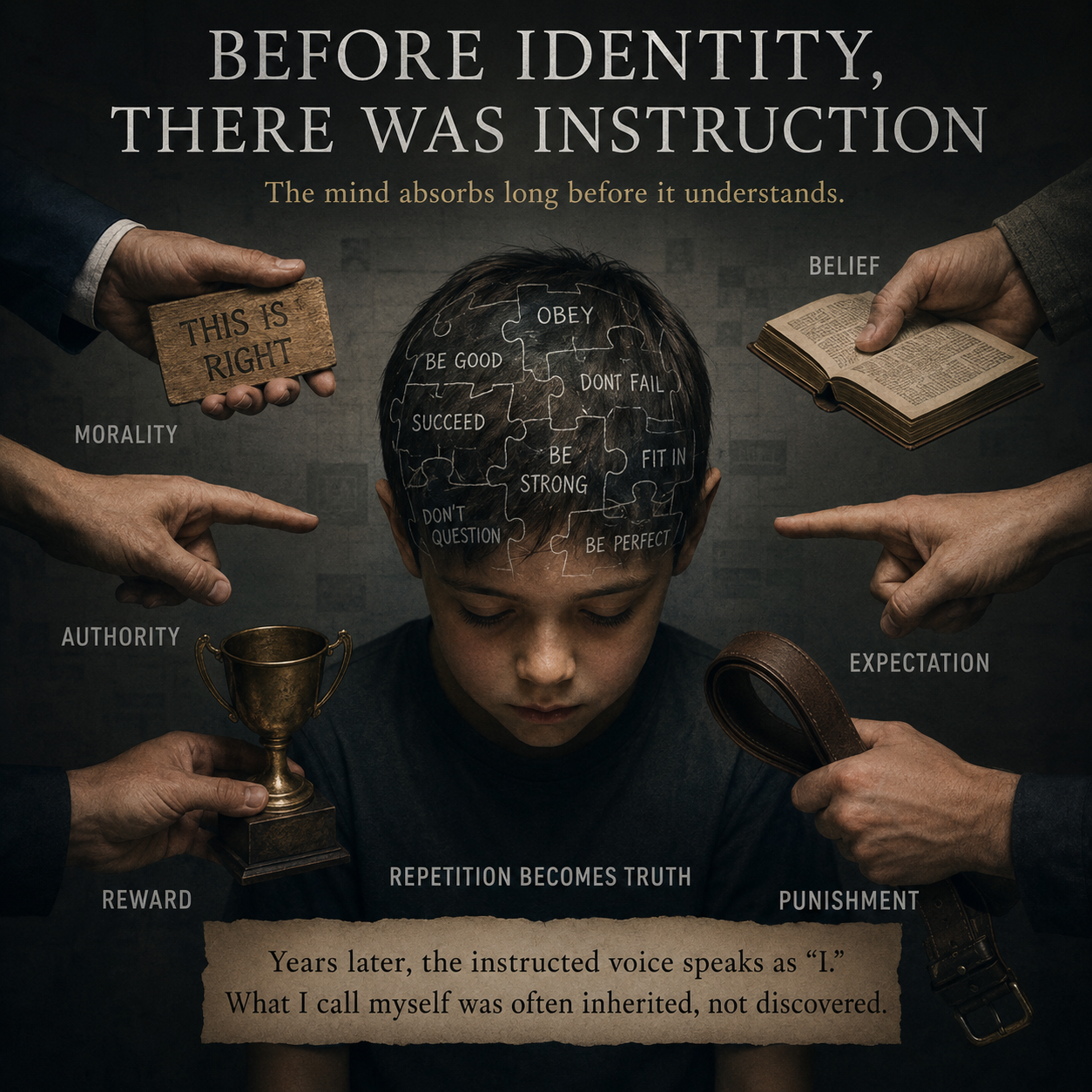
Long before any of us formed conclusions about life, conclusions were being formed around us.
Instructions come first.
Instruction about behaviour, success, morality, gender, intelligence, love, and value.
Nobody told us the process is called conditioning.
People often referred to the process as education, parenting, culture, tradition, religion, responsibility, maturity, or guidance.
The names do not change the fact.
Every child enters a world that is already organised by beliefs.
The child does not choose the structure.
The child inherits the structure.
Language itself is inherited.
Before you could describe reality, reality had already been described for you.
People often speak about identity as though it is something that is discovered.
Most identity is absorbed.
Every child watches and observes tone, facial expression, approval, disappointment, conflict, reward, and punishment.
The child learns what keeps the connection intact.
Very little of the process is conscious.
That unconscious process later becomes personality.
People speak proudly about their personal opinions.
Most personal opinions arrived through repetition long before examination.
Repetition creates familiarity.
Familiarity creates emotional attachment.
Emotional attachment creates a sense of certainty.
Certainty then calls itself truth.
You may believe you think independently while speaking with inherited language, fears, ambitions, and definitions of success.
The mind protects the familiar because familiarity once protected survival.
A child who fails to adapt is at risk of exclusion.
Exclusion is dangerous to a dependent organism.
Adaptation, therefore, is viewed as intelligence.
Obedience becomes safety.
Imitation becomes normal.
In time, the same person calls the accumulated structure “me.”
Very few people stop to examine the structure.
How much choice existed before psychological instruction became identity?
To the sharp mind, this question creates discomfort because instruction often hides beneath innocence.
Parents believe they are helping.
Teachers believe they are preparing.
Religions believe they are guiding.
Societies believe they are civilising.
Belief in good intentions does not prevent psychological influence.
An anxious parent transfers anxiety without language.
A fearful culture trains fear without admitting fear.
A society obsessed with status teaches comparison before the child develops self-awareness.
Malicious intent is not required for conditioning to spread.
Conditioning survives through normality.
The most powerful forms of instruction rarely appear violent.
The most powerful forms of instruction appear reasonable.
That is why conditioning survives across generations.
People inherit emotional patterns as naturally as surnames.
We inherit silence, shame, and ambition.
Some inherit fear of authority.
Others inherit worship of authority.
People then defend the inheritance as individuality.
Most people do not build identity from direct perception.
Most people form their identity from accepted instruction.
The entire process is almost impossible to detect because the conditioned person examines life through conditioned perception.
The observer is shaped by the structure being observed.
That fact entirely changes the meaning of self-examination.
Self-examination is not merely reflection on behaviour.
Self-examination includes suspicion toward the entire framework from which behaviour emerges.
Without that suspicion, introspection easily becomes rearrangement inside the same prison.
A person may reject one ideology only to become psychologically dependent on another.
A person may rebel against parents while preserving the same emotional structure.
A person may abandon religion while remaining deeply conditioned by moral fear.
External change does not guarantee internal clarity.
Instruction does not disappear when rebellion begins.
Instruction often speaks through rebellion itself.
The mind prefers continuity.
Even resistance can become imitation.
Most people never encounter a moment untouched by instruction.
Every reaction, preference, ambition, and fear feels personal because conditioning operates viscerally.
The conditioned mind rarely experiences itself as conditioned.
The conditioned mind experiences itself as reality.
That confusion shapes almost every human conflict.
All conflict is internal; every problem is relational.
Nations kill through inherited belief.
Families fracture through inherited fear.
Relationships collapse through inherited insecurity.
Individuals suffer through inherited standards they never consciously chose.
People call the resulting struggle “human nature.”
Much of the struggle may simply be inherited instruction operating without examination.
A human being trained to seek approval eventually fears disapproval more than falsehood.
A human being trained to obey eventually mistakes authority for intelligence.
A human being trained to perform eventually loses contact with direct experience.
Life then becomes performance responding to inherited commands.
Most people never realise that any of this ever happened.
That’s the tragedy.
A mind that mistakes conditioning for identity cannot see clearly because the conditioning speaks as the self.
The voice of external instruction eventually becomes the internal voice saying, “This is who I am.”

Instruction: The Foundation of Identity - Deep-dive
Instruction: The Foundation of Identity - Addendum